
How to Correct a VAT Return: Fixing VAT Errors Without Making Things Worse

How to Correct a VAT Return: Fixing VAT Errors Without Making Things Worse
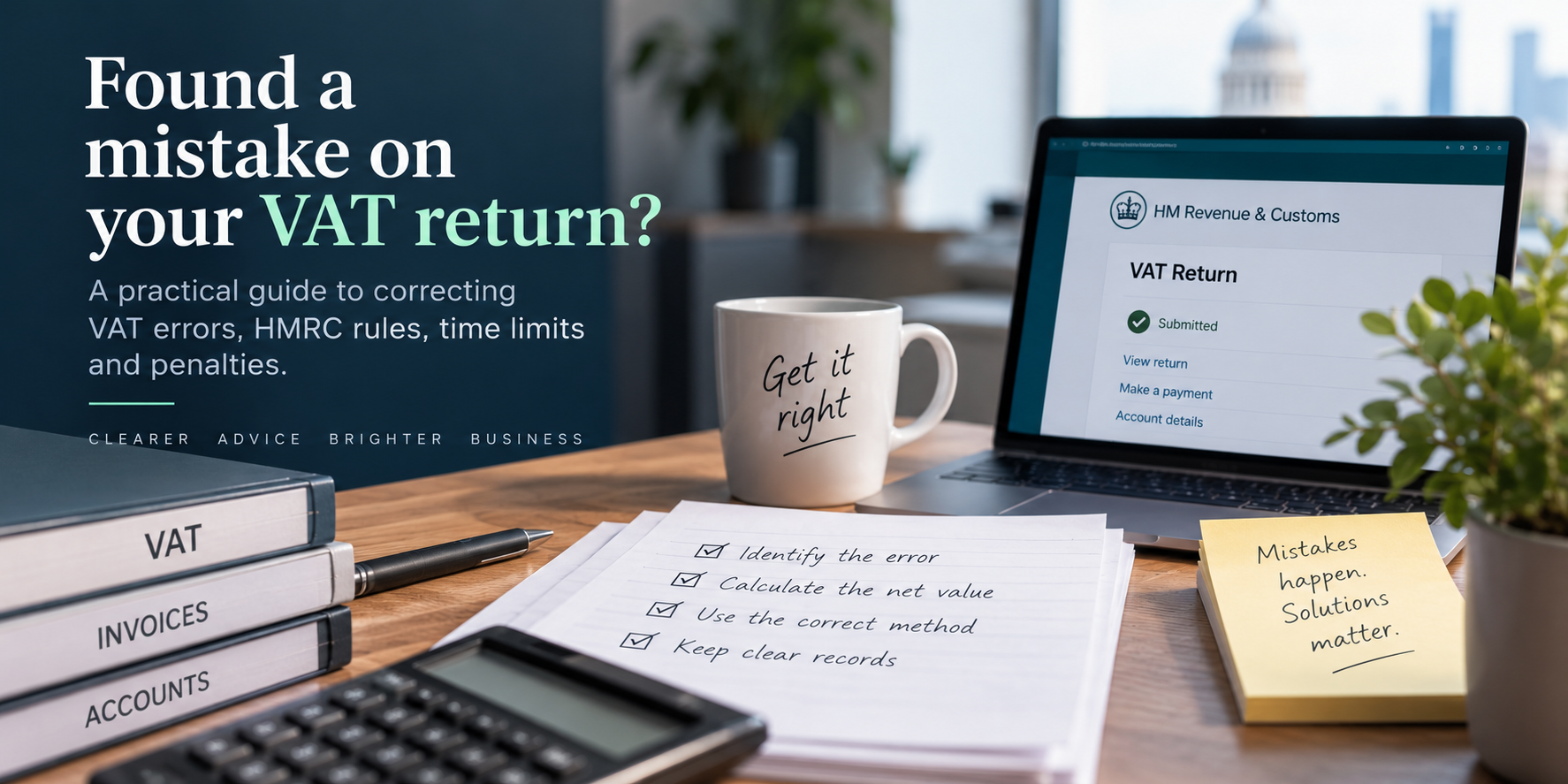
Spotting a mistake on a VAT return can be worrying, particularly if the return has already been submitted. The good news is that HMRC has a clear process for putting genuine errors right. What matters most is identifying the problem, calculating its value and using the correct correction method.
At AccountingPreneur, we often find that the original mistake is less serious than the uncertainty that follows it. A missed purchase invoice, an incorrect VAT code or a figure entered in the wrong box can usually be corrected cleanly when the records are clear and action is taken promptly.
This guide explains how UK businesses can correct VAT errors under HMRC VAT Notice 700/45, including Method 1, Method 2, time limits, penalties and the records you should keep.
Has the VAT Return Already Been Submitted?
If you find an error before submitting the VAT return, amend your accounting records, keep a note explaining the correction and make sure the right figure flows through to the return for that period.
If the return has already been submitted, you cannot simply reopen it and replace the figures. Instead, you need to use HMRC's VAT error correction process.
Record the Error Before You Correct It
As soon as you identify a problem, create a clear record showing when it was discovered, the VAT period affected, what caused it, whether it concerns input or output tax and the amount involved. Keep the related invoices, calculations and other supporting documents.
Good bookkeeping records make this much easier. If invoices, VAT codes and reconciliations are already organised, you can establish the cause and value of the mistake without rebuilding months of transactions.
Calculate the Net Value of the Errors
Before choosing a correction method, calculate the net value of all relevant errors from previous returns discovered during the current VAT period.
Add together amounts due to HMRC, such as under-declared output VAT or input VAT that was over-claimed. Then subtract amounts due back to your business, such as output VAT that was over-declared or input VAT that should have been claimed.
For example, if you discover £8,000 of output VAT that should have been declared but also find £2,000 of missed input VAT, the net error is £6,000 due to HMRC. Deliberate errors are treated separately and must be notified to HMRC.
Method 1: Correcting Smaller VAT Errors
Method 1 allows qualifying errors to be corrected through the VAT return for the period in which you discover them. You can normally use it where the net value:
- Does not exceed £10,000; or
- Is between £10,000 and £50,000 and does not exceed 1% of the Box 6 net outputs figure on the current return.
If the net amount is tax due to HMRC, include it in Box 1. If VAT is due back to the business, include the net amount in Box 4. Record the correction clearly in your VAT account with enough detail to show how it was calculated.
Method 1 is not automatically a disclosure for penalty purposes. If the original error was careless, HMRC says you should also tell them separately if you want the disclosure to be considered when any penalty is calculated.
Method 2: When You Must Notify HMRC
Method 2 is used for larger errors and deliberate inaccuracies. You must normally notify HMRC separately if:
- The net error is between £10,000 and £50,000 and exceeds 1% of the current Box 6 figure.
- The net error is greater than £50,000.
- The error was deliberate, regardless of value.
You can also choose Method 2 for a smaller error.
HMRC provides an online service for reporting VAT return errors. The notification should explain how the error arose, the periods affected, whether it concerns input or output tax, the VAT under-declared or over-declared and how you calculated the figures.
If you cannot use the online service, HMRC also publishes postal, telephone and email contact details in VAT Notice 700/45. Check the current guidance before sending sensitive information.
Do Not Delay a Clearly Large Error
You would normally review errors discovered during the current accounting period before deciding which method applies. However, if an individual error is clearly large enough to breach the 1% Box 6 test or £50,000 limit, HMRC says you should make a Method 2 notification immediately.
What Is the Time Limit for Correcting VAT Errors?
The general error correction time limit is four years. For under-declared or over-declared output tax and over-claimed input tax, it generally runs from the end of the accounting period in which the error occurred. For under-claimed input tax, it generally runs from the due date of the relevant return.
Certain tax-point timing errors have special rules, and deliberate errors are treated differently. Do not assume an old deliberate inaccuracy is outside HMRC's reach.
Will HMRC Charge a Penalty?
Not every VAT mistake results in a penalty. HMRC distinguishes between errors made despite taking reasonable care, careless errors and deliberate errors.
If you took reasonable care and still made a genuine mistake, a penalty should not normally arise. Once you discover the error, however, you are expected to correct it. Where an error was careless or deliberate, penalties can apply, and the outcome can be influenced by whether the disclosure was prompted or unprompted and how much assistance you provide.
Making a full disclosure before HMRC begins enquiries will generally put you in a better position than waiting until the mistake is found during an inspection.
Can HMRC Charge Interest?
Yes. If the error meant VAT was not paid by the original due date, late payment interest can apply. Interest and penalties are separate, so correcting the VAT does not necessarily remove the interest resulting from late payment.
After a Method 2 notification is processed, HMRC normally sends a notice confirming the correction and any interest. Its current guidance says to contact the VAT Error Correction Team if you have not heard back within 40 working days.
Not Every VAT Adjustment Is an Error
Bad Debt Relief, credit notes, partial exemption adjustments and certain Capital Goods Scheme adjustments are not automatically VAT errors. For example, if you correctly accounted for VAT on a sale and the customer later failed to pay, the original return was not necessarily wrong. Bad Debt Relief has its own rules.
Only where the original adjustment itself was wrong, or made at the wrong time, would the normal error correction process apply.
Overpaid Output VAT and Unjust Enrichment
If you overpaid output VAT and seek a refund, HMRC can consider whether repaying it would unjustly enrich the business. This may apply where the extra VAT cost was passed on to customers and the business would retain the refund rather than reimburse them.
HMRC operates a reimbursement scheme for relevant cases. Seek professional advice where a significant output VAT repayment is involved.
Keep a Clear VAT Correction Audit Trail
VAT records generally need to be kept for at least six years. Keep your error log, original and corrected calculations, relevant invoices, reconciliation reports, copies of notifications and HMRC correspondence together.
If you use digital records, make sure these documents remain accessible and form a clear trail from the original transaction to the correction. HMRC's VAT record-keeping guidance explains the wider requirements.
How to Prevent the Same VAT Error Happening Again
VAT mistakes often expose a process issue rather than a one-off problem. Incorrect VAT codes, missing invoices and unreconciled accounts can repeat unless the underlying cause is addressed.
Regular reconciliations, a second-person review of unusual transactions and careful checking of automated VAT coding can reduce the risk. Accurate digital bookkeeping also makes it easier to identify discrepancies before a VAT return is submitted.
When Should You Speak to a VAT Accountant?
Small, straightforward errors may be easy to correct internally. Professional advice becomes more valuable where several VAT periods are affected, the amount is significant, you are unsure whether the error was careless, or the issue involves partial exemption, international transactions or another technical area.
AccountingPreneur's VAT services can help review the underlying records, establish the net value of an error and determine the appropriate correction route. Where necessary, we can also help prepare the information needed for a formal HMRC notification.
If the error forms part of a wider tax issue, our tax advisory services can provide additional support and guidance.
Frequently Asked Questions
Can You Amend a VAT Return After It Has Been Submitted?
You do not normally edit the original submitted return. Qualifying errors are corrected through the current VAT return using Method 1 or reported separately to HMRC using Method 2.
What Is the Difference Between Method 1 and Method 2?
Method 1 generally covers smaller net errors within HMRC's limits and allows the adjustment to be made on the current return. Method 2 is a separate notification and is required for larger or deliberate errors.
What Happens If You Ignore a VAT Error?
If HMRC later identifies under-declared VAT, it can assess the tax due and may charge interest and penalties. Correcting the error promptly is usually far better than leaving it unresolved.
Final Thoughts
Finding a VAT mistake is not the point at which things go wrong. The real risk comes from failing to understand it, using the wrong correction method or leaving it unresolved.
Record the error, calculate its net value, establish whether Method 1 or Method 2 applies and keep a clear audit trail. If the position is unclear, seek advice before submitting the correction. Handled properly, most genuine VAT errors can be corrected without becoming a major problem.
Get in touch today to see how we can help you!
Contact us
.png)




.png)
-min.png)

.png)


