
What Documents Should You Keep for HMRC? A Record-Keeping Guide

What Documents Should You Keep for HMRC? A Record-Keeping Guide
Good record keeping is about far more than staying on the right side of HMRC. Accurate records help you manage cash flow, claim allowable expenses, prepare tax returns with confidence, and make better business decisions throughout the year.
Whether you are self-employed, a sole trader, a limited company director, or a small business owner, keeping the right documents is a legal requirement. It also makes life much easier when deadlines come around.
This guide explains what documents you should keep for HMRC, how long to retain them, and how to stay organised with digital records. If your records are already difficult to manage, professional bookkeeping services can help keep everything accurate, organised, and compliant.
Why HMRC Record Keeping Matters
Every figure you include on a tax return should be supported by evidence. If HMRC asks a question later, you need to show where the numbers came from.
Good records help you prove income, support expense claims, prepare VAT returns, manage payroll, and file accounts correctly. Poor records can lead to mistakes, missed deductions, late submissions, and unnecessary stress.
HMRC can charge penalties where businesses fail to keep adequate records or submit inaccurate tax information. The simplest way to reduce that risk is to keep clear, complete, and well-organised records throughout the year.
What Documents Should You Keep for HMRC?
You should keep documents that support your income, expenses, tax returns, VAT returns, payroll records, and company accounts. In practical terms, this usually includes invoices, receipts, bank statements, contracts, payroll records, VAT records, and accounting reports.
If a transaction affects your tax position, you should keep evidence of it.
Core records normally include:
- Sales invoices and income records
- Purchase receipts and expense records
- Bank statements and credit card statements
- VAT records and VAT return reconciliations
- Payroll records and PAYE information
- Loan agreements and finance documents
- Contracts with clients, suppliers, and landlords
- Company records, where relevant
Business Income Records
Income records prove what your business has earned. These are especially important because HMRC expects your tax return to include all taxable income.
For most businesses, income records include sales invoices, till reports, online sales reports, payment processor statements, bank deposits, and records of any other income received.
If you receive income from several sources, keep each source clearly recorded. This is especially important for businesses with trading income, rental income, dividends, interest, or income from online platforms.
Expense Records and Receipts
Expense records support the costs you claim against your business income. Without proper evidence, you may lose valuable tax deductions.
Keep receipts and invoices for business expenses such as stock, materials, travel, software, subscriptions, professional fees, insurance, marketing, and office costs.
Where an expense has both personal and business use, keep a clear calculation showing the business proportion. This is common with mobile phones, home office costs, vehicles, and mileage claims.
The more clearly you record expenses at the time, the easier it is to prepare accurate tax returns later.
Bank Statements and Credit Card Statements
Bank statements provide an important audit trail for business activity. They help confirm income received, payments made, transfers, loan repayments, and cash withdrawals.
Business owners should keep separate business bank statements where possible. Mixing personal and business transactions makes record keeping more difficult and can create confusion at tax time.
Monthly bank reconciliation is also important. This means checking your bank statements against your bookkeeping records to make sure every transaction has been recorded correctly.
Records for Sole Traders and the Self-Employed
If you are self-employed, you must keep records of all business income and expenses so you can complete your Self Assessment tax return correctly.
This includes sales invoices, receipts, bank statements, mileage logs, details of business use of home, records of stock, and any other evidence supporting the figures on your return.
If you need help preparing or checking your return, our Self Assessment tax return services can help ensure your income, expenses, and allowances are reported correctly.
HMRC provides official guidance on keeping records for self-employed people here: keeping business records if you are self-employed.
Records for Limited Companies
Limited companies have additional record-keeping responsibilities. Company records must support annual accounts, Corporation Tax returns, Companies House filings, and decisions made by directors and shareholders.
Limited company records usually include:
- Sales invoices and purchase receipts
- Bank statements and accounting records
- Corporation Tax calculations
- Company registers
- Board minutes and shareholder resolutions
- Dividend vouchers
- Directors' loan account records
- Details of assets owned by the company
These documents help show how money moves in and out of the company. They also support accurate year-end accounts and Corporation Tax returns.
VAT Records
If your business is VAT registered, you must keep VAT records that show how each VAT return has been prepared.
VAT records usually include sales invoices, purchase invoices, VAT account summaries, import and export documents, credit notes, debit notes, and VAT return reconciliations.
Accurate VAT records make it easier to file returns correctly and respond to HMRC questions. If VAT is becoming difficult to manage, our VAT services can support VAT returns, Making Tax Digital requirements, and ongoing compliance.
Payroll and PAYE Records
If you employ staff, payroll records must be kept accurately. These records support PAYE, National Insurance, pension contributions, statutory payments, and Real Time Information submissions to HMRC.
Payroll records usually include:
- Employee pay details
- Tax codes
- National Insurance information
- Payslips
- PAYE calculations
- RTI submissions
- Statutory Sick Pay and family leave records
- Pension contribution records
Payroll data should also align with your bookkeeping records so wage costs, PAYE liabilities, and pension payments are reflected correctly in your accounts.
For support with employee pay, deductions, RTI submissions, and compliance, our payroll services can help keep payroll accurate and on time.
CIS Records for Construction Businesses
Businesses operating under the Construction Industry Scheme need to keep records of payments made to subcontractors and deductions withheld.
These records should show the subcontractor details, gross payment, cost of materials, deduction rate, deduction amount, and net payment made.
Clear CIS records help prevent disputes and support accurate reporting to HMRC.
Digital Records and Making Tax Digital
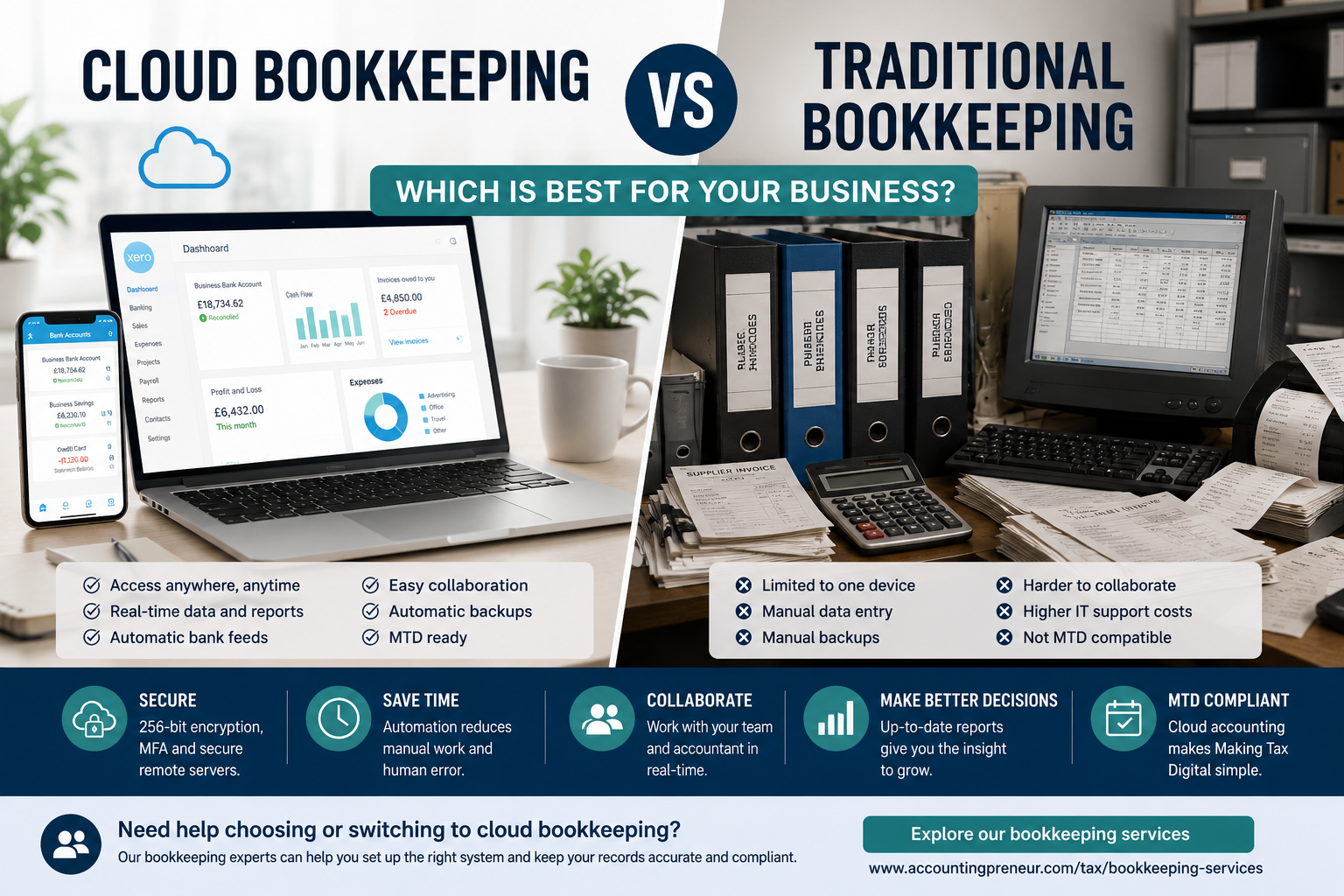
Digital record keeping is becoming increasingly important. Making Tax Digital requires many businesses to keep digital records and submit information using compatible software.
For VAT-registered businesses, Making Tax Digital already applies in many cases. Making Tax Digital for Income Tax is being phased in from April 2026 for sole traders and landlords above the relevant income thresholds.
You can check the official HMRC guidance on Making Tax Digital for Income Tax.
Digital records do not need to be complicated. Cloud accounting software can help capture receipts, import bank transactions, reconcile accounts, and keep a clear audit trail.
Can You Keep Digital Copies Instead of Paper?
In most cases, yes. HMRC generally accepts digital copies as long as they are complete, readable, and available if requested.
Scanning receipts, uploading supplier invoices, and storing documents securely in cloud accounting software can make record keeping much easier.
The key is to make sure digital records are organised, backed up, and easy to retrieve.
How Long Should You Keep Records?
Retention periods depend on your business structure and the type of tax involved.
For Self Assessment, records are usually kept for at least five years after the 31 January submission deadline for the relevant tax year.
Limited companies normally need to keep accounting records for at least six years from the end of the relevant accounting period.
VAT records are usually kept for at least six years.
If HMRC opens an enquiry or investigation, records should be kept until the matter is fully resolved, even if that means retaining them for longer.
What Happens if Records Are Missing?
Missing records can happen. Receipts get lost, suppliers stop trading, and bank documents may no longer be available online.
If records are missing, act quickly. Request duplicate bank statements, contact suppliers for copies of invoices, check emails for order confirmations, and rebuild the transaction history as accurately as possible.
If you have to use estimated or provisional figures, make sure this is clearly explained. Do not ignore missing records or guess without keeping notes on how the figures were calculated.
How to Keep Records Organised
A simple routine is usually enough to prevent most record-keeping problems.
Start by separating business and personal finances. Then set aside time each week to upload receipts, reconcile bank transactions, and check outstanding invoices.
Use clear folder names and consistent labels so records can be found quickly. For example, organise documents by tax year, month, and category.
Cloud accounting software can make this process far easier by storing documents against individual transactions.
Security and Backups
Business records often contain sensitive information, so security matters.
Use strong passwords, two-factor authentication, restricted access, and secure cloud storage. Backups should be tested regularly so you know records can be recovered if something goes wrong.
A good approach is to keep multiple copies of important records, including one secure backup away from your main system.
HMRC Record-Keeping Checklist
Use this checklist to confirm whether your records are complete:
- Sales invoices and income records
- Purchase receipts and expense invoices
- Bank and credit card statements
- VAT records and VAT returns
- Payroll and PAYE records
- Loan and finance agreements
- Contracts and supplier agreements
- Mileage logs and business-use calculations
- Dividend vouchers and directors' loan account records
- Company minutes and statutory records
Review Your Records Regularly
Record keeping works best when it becomes part of your routine rather than something you tackle once a year.
A quarterly review can help you check whether receipts are missing, invoices remain unpaid, VAT records are complete, payroll journals are posted, and bank reconciliations are up to date.
Businesses that keep records current usually find tax returns easier, cash flow clearer, and year-end accounts less stressful.
Final Thoughts
Keeping the right documents for HMRC is not just about avoiding penalties. It gives you confidence in your numbers, helps you claim the right expenses, improves cash flow visibility, and supports better decision-making.
Start with the basics: keep income records, expense receipts, bank statements, VAT records, payroll records, and company documents where relevant. Then create a simple weekly or monthly routine so records stay organised throughout the year.
If you would like help organising your records, preparing for Making Tax Digital, or keeping your bookkeeping accurate throughout the year, speak to our accountants in Fitzrovia. We can help you build a simple record-keeping system that saves time, reduces errors, and keeps your business compliant.
Get in touch today to see how we can help you!
Contact us




.png)
-min.png)

.png)


